
Global ObusForme® Lumbar Support Explained
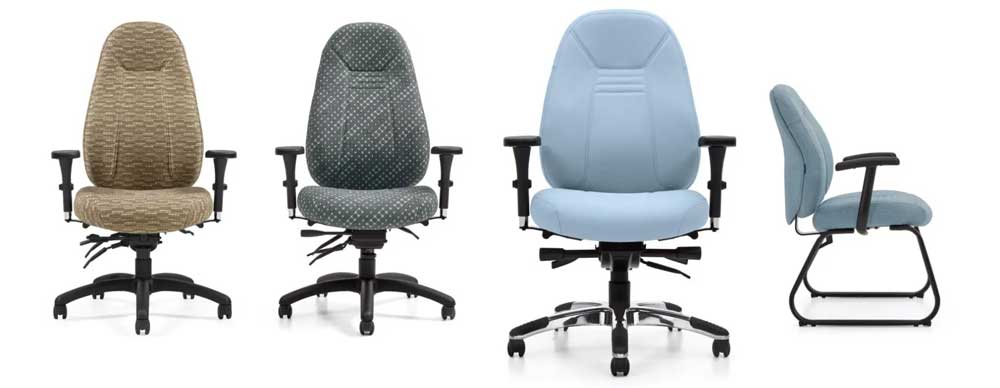
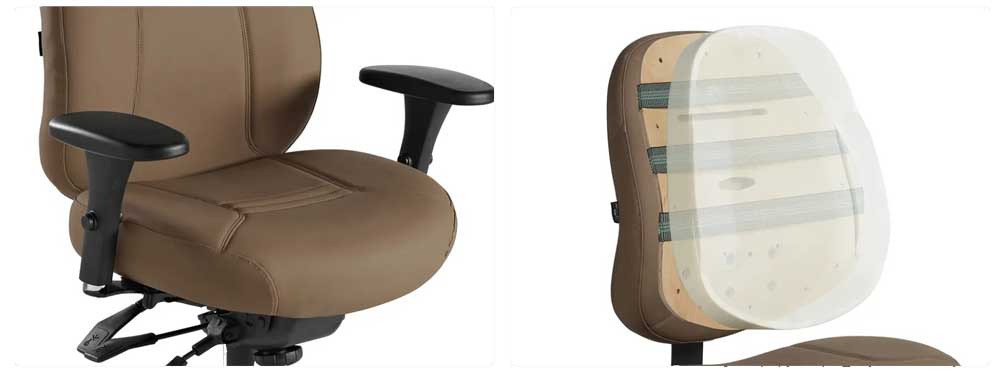
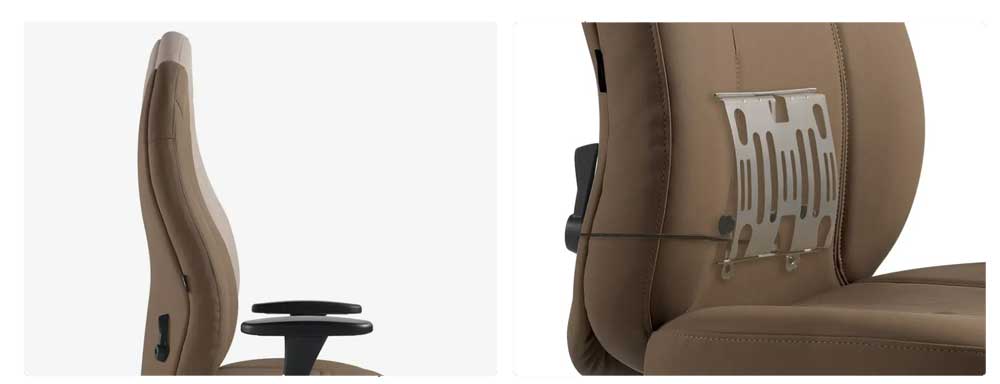
When an employee tells you their back hurts, the instinct is to act fast. Replace the chair. But replace it with what? Walk into any office furniture showroom and you'll hear the word "lumbar" used to describe everything from a foam pad glued to a mesh back to a sophisticated multi-axis support system that took engineers a decade to develop. Not all lumbar support is created equal. For office managers responsible for an entire team’s comfort and productivity, understanding the differences can help avoid costly mistakes. At the heart of the Global ObusForme® Comfort series is an elastomeric back support system designed around the natural S-curve of the spine. The chairs are made in Canada, meet or exceed all applicable BIFMA standards for safety and durability, and are backed by one of the strongest warranties in commercial office seating. More importantly for your employees, the lumbar support design is genuinely different from what you'll find in most office chairs. Here's what that technology actually does, why it matters, and how to choose the right model for your team. Your spine has a natural S-curve. The lower portion, the lumbar region, curves inward toward your abdomen. When you sit without proper support, gravity gradually flattens that curve. Your pelvis tilts backward. Your lower back rounds. Your upper back compensates by hunching forward. After a few hours, the muscles, discs, and ligaments in your lower back are working much harder than they should be. The result is the kind of back pain that starts as a minor ache at 2pm and becomes the reason someone files a workplace accommodation request by the end of the month. Proper lumbar support maintains that inward curve, keeping the spine in its natural position throughout the day. This reduces the muscular effort required to sit upright, takes pressure off the intervertebral discs, and allows employees to sit comfortably for longer without fatigue. The challenge is that no two spines are identical. People vary in height, torso length, the degree of their natural lumbar curve, and the firmness of support they find comfortable. A lumbar system that works perfectly for a 6'1" project manager may be entirely wrong for a 5'3" administrative coordinator sitting in the same office. This is the problem the ObusForme® system was designed to solve. At the core of every ObusForme® Comfort chair is an elastomeric back support system. This is a flexible polymer framework built into the backrest that provides even, gentle support across the entire lumbar region without creating pressure points along the spine. Unlike rigid foam lumbar pads that push against one fixed point on your back, the elastomeric system distributes support across the full contact area of the backrest. As you shift your position, lean slightly to reach something on your desk, or adjust your posture throughout the day, the backrest moves with you rather than pressing against a fixed point. The backrest itself is height adjustable using a full ratcheting system with 2.25-inch increments, so you can position the lumbar curve exactly where each employee's lower back needs it. Whether someone is 5'2" or 6'3", the support zone can be moved to align with their actual lumbar region rather than some assumed average. This combination of flexible elastomeric support and precise height adjustment is what sets the system apart. Rather than assuming one back shape fits everyone, it lets the support adapt to the person actually sitting in the chair, which is why it works as intended for such a broad range of users. The ObusForme® Comfort series offers two distinct lumbar support options, and choosing between them is one of the more important decisions an office manager makes when placing a chair order. The standard lumbar configuration uses the elastomeric back support system with height adjustment as the primary means of customization. The backrest height can be raised or lowered to align the support curve with each user's lumbar region. The seat depth slider allows the distance between the seat and backrest to be adjusted, ensuring users sit back in the chair properly rather than perching at the edge. This configuration handles the ergonomic needs of the majority of office users, particularly those without pre-existing back conditions who simply need a well-designed chair to maintain good posture throughout the day. Best for: Standard office users working typical 7 to 9 hour days, hot-desking environments where different people use the same chair, budget-conscious orders where per-chair cost is a priority, and offices replacing an existing fleet of standard task chairs. Models: 1240-3 (High Back, most popular), 1241-3 (Medium Back, more compact) The Schukra lumbar system goes further. In addition to height adjustment, the Schukra mechanism adds depth adjustment, which controls how far the lumbar support protrudes into your lower back, and firmness adjustment, which controls the tension of the support. The practical result is a chair that can be tuned to individual preference with a precision that fixed systems cannot match. An employee with a pronounced lumbar curve needs more forward protrusion than someone with a flatter lower back. An employee who prefers firm, constant support has different needs from one who prefers a softer, more yielding feel. The Schukra system accommodates all of these variations. For employees who sit for extended hours, have reported back discomfort with previous chairs, or have specific ergonomic requirements on file, the Schukra upgrade is the more appropriate choice. Best for: Employees working 8 or more hours daily, staff members who have reported back pain or discomfort, management and executive positions where maximum comfort is a priority, offices with a diverse workforce spanning a wide range of body types, and healthcare facilities where ergonomic compliance is taken seriously. Models: 1260-3 (High Back with Schukra), 1261-3 (Medium Back with Schukra) The price difference: The Schukra models carry a modest premium over the standard versions, typically around $50 per chair. For an office ordering 20 chairs, that's a total upgrade cost of roughly $1,000 to provide meaningfully better lumbar support to every employee. Most office managers consider it one of the easier budget decisions they make. When you're placing an order for a mixed workforce, here is a working framework. For most employees on a standard 7 to 9 hour day with no known back issues, the 1240-3 High Back with standard lumbar handles the ergonomic needs of the majority of your workforce. It ships in 2 to 5 days and gives you the best value per chair. For employees who sit 8 or more hours or who have reported back discomfort, upgrade to the 1260-3 High Back with Schukra. The roughly $50 per chair premium is a fraction of the cost of a WorkSafe claim or accommodation process. For employees with shorter torsos or under 5'4" in height, consider the Petite seat option available on both the 1240-3 and 1241-3. The petite configuration has a shallower seat depth and a lower seat height range, ensuring the lumbar support actually reaches the right position for smaller users. For conference rooms and meeting spaces, the 1241-3 Medium Back or guest chair variants work well. Conference chairs typically accommodate a range of users for shorter periods, making the medium back a practical and cost-effective choice. For a complete walkthrough of every model in the family, including sizing guidance and fabric options, see our ObusForme® Buying Guide for Office Managers. At some point, most office managers have to justify a seating purchase to a facilities director, HR team, or CFO. The ObusForme® Comfort series gives you specifics that hold up to scrutiny, all drawn from Global's published product specifications. The chairs meet or exceed all applicable BIFMA standards for safety and durability, the benchmark testing standard for commercial office furniture in North America. They are manufactured in Canada in ISO 9001 and ISO 14001 certified facilities, which speaks to both quality management and environmental practices, and buying Canadian-made matters to many procurement policies. All fabric and foam is tested and certified to California Technical Bulletin 117 fire safety standards. And the warranty is among the strongest in commercial seating: lifetime coverage on all components, with foams and fabrics covered for 5 years and control mechanisms for 12 years. It's the difference between telling your CFO "we bought comfortable chairs" and "we implemented a seating program built on BIFMA-certified, Canadian-made chairs with a lifetime warranty." One of those gets follow-up questions. The other gets approved. The Schukra lumbar support is a highly adjustable, mechanical lower-back support system integrated into select Global ObusForme® models. It allows you to customize both the depth and curvature of the lumbar support to match your spine's natural S-shape. Unlike basic lumbar pads that push against one fixed point, the Schukra system lets you adjust how far the support protrudes into your lower back and how firm the support feels. It's controlled via a discreet manual lever on the back of the chair rather than air pumps or electronic controls. This precision adjustment is why the Schukra upgrade is particularly valuable for employees with specific ergonomic needs or existing back discomfort. For employees who sit 8 or more hours daily, employees who have reported any back discomfort, or anyone in management positions where maximum comfort is a priority, the Schukra upgrade is worth the investment. Your employees' backs and overall health will benefit from the additional adjustment capability. For standard office users working typical 7 to 9 hour days without known back issues, the standard ObusForme® lumbar system handles their needs well. A practical approach is to upgrade key positions to Schukra and use standard lumbar for general seating, giving you the best balance of cost and ergonomic support across your workforce. In most cases, yes, depending on the specific condition. The combination of the Schukra adjustable lumbar support and the comprehensive ergonomic features of the ObusForme® chair should allow your employee to customize the chair to reduce discomfort significantly. The elastomeric back support system provides even support without pressure points, and the Schukra mechanism adds the precision adjustment needed to accommodate individual spinal curves and support requirements. For employees with documented medical conditions, the chair can be part of a workplace accommodation solution. However, we recommend the employee work with their healthcare provider to ensure the chair configuration meets their specific medical needs. There is a discreet lever located on the back of the chair, typically positioned on the lower right or left side of the backrest. Simply reach behind the chair and adjust the lever to increase or decrease the depth and firmness of the lumbar support until it matches your spine's natural curvature. The adjustment is intuitive and can be fine-tuned while seated. Most users find their ideal setting within a few minutes of trying different positions. The back height adjustment (ratcheting system) is controlled separately and should be set first to position the lumbar zone at the correct height for your lower back before fine-tuning the Schukra depth and firmness. Yes. The Schukra mechanism is covered under Global's warranty. Global provides a lifetime warranty on all components, with two exceptions: foams and fabrics are covered for 5 years, and control mechanisms are covered for 12 years. The Schukra lumbar mechanism falls under the control mechanism coverage, giving you 12 years of protection under normal commercial use. This is one of the reasons the Schukra upgrade represents good value. You're not just paying for additional adjustment capability, you're getting a warranted mechanical system built to last. Yes, the Schukra system is designed to be user-adjustable, making it suitable for shared workstations where different employees use the same chair on different days. Each user can quickly adjust the lumbar depth and firmness to their preference using the lever control. This is actually one of the advantages of the mechanical Schukra system over fixed lumbar pads, which cannot adapt to different users' needs. No, the external appearance is identical. The Schukra mechanism is integrated into the backrest and controlled by a discreet lever. There are no visible differences between a standard 1240-3 and a Schukra-equipped 1260-3 when looking at the chairs from the front or side. This allows you to mix standard and Schukra models in the same office without creating a visual distinction between upgraded and standard seating. OfficeSeating.ca stocks the complete ObusForme® Comfort series with free shipping across Canada.Why Office Managers Choose This Technology
Why Lumbar Support Matters More Than You Think
The ObusForme® Elastomeric Back Support System
Standard vs. Schukra: Choosing the Right Lumbar Level
Standard Lumbar: The ObusForme® 1240-3 and 1241-3
Schukra Adjustable Lumbar: The ObusForme® 1260-3 and 1261-3
A Practical Guide for Office Managers: Which Model for Which Employee?
Credentials That Hold Up in a Purchase Justification
Frequently Asked Questions
Order with Confidence